At RCS Australia, we are strong proponents of Steven Covey’s work as a management consultant and educator. One of Covey’s first principles in management is to do the right things well. That is, to be effective, not just efficient. One of the great conundrums of modern life is that it is possible to be 100% efficient and 0% effective. In no industry is this truer than in agriculture. You could, for example, spend an entire career focused on production efficiency, without ever generating a true profit or creating real wealth.
Regenerative agriculture and misconceptions
In a recent caricature, ‘regenerative agriculture’ was painted as the ‘Do Nothing’ approach to farming. The problem with naming and labelling things is that they then get depicted as simplistic phantoms. Regenerative agriculture, despite what its detractors may think, is not about ‘doing nothing’; it is about doing the right things well. In fact, in the USA, the time-controlled grazing that we teach and advocate for at RCS (how to grow more grass and build long-term soil carbon) is called “management intensive grazing” or MiG. It’s not that there is more to do per se, one of the oft-cited detractions, but there is more management, observation, intuition, tuning into one’s landscape, and strategic decision-making to optimise animal and landscape health and performance. In fact, we often see clients who progressively manage more Animal Units (DSE or LSU) per Full Time Equivalent employee – that is, their labour efficiency goes up!
The Grazing for Profit school follows its name. We teach people how to run grazing and farming businesses that align with their personal objectives and build profitability and long-term wealth. I have the great privilege as a business coach and facilitator to work with people along this journey. Many of them, most of them, name building landscape health as a priority for them and their farming legacy. Often, this can mean slightly different things, and there are many ways to get there, but most want to see their soil carbon going up, their reliance on off-farm energy and inputs go down, and the health of their system improving. They want more ecological health, more profit for themselves, and the capacity to reinvest in local communities. And last, but not least, they want improved personal health and well-being. Now, maybe one could call all that regeneration.
Practical grazing management: Moving beyond “Do Nothing” thinking
If a client were to tell me their plan was to remove all superphosphate and lime from their grazing system, sit on their hands, and wait for Nirvana to arrive, I would suggest it is likely not an effective strategy. However, if they were to say, “I’d like to build deep-rooted perennial plants, generate more production relative to my direct costs, and reduce my overheads relative to my gross production,” then I’d say, “That sounds a lot like you want to start Farming & Grazing for Profit!”
One of the problems with change is that it is not a linear process. Nature is not linear, and systems take time to adapt and build. This flies in the face of ‘linear input = output’ thinking. Applications of salt-based fertilisers appear linear. I put ‘x’ on, and I get ‘y’ additional production of grass. There are two problems with this. One, most people never measure the additional production. Two, most don’t account for the downstream effects on soil carbon and soil biology. It’s no accident that we put lime and super out together. Applying super (and urea) is a very acidifying thing to do to a soil. Super can also damage the plants’ symbiotic relationship with mycorrhizal fungi, which trade with the plant, Phosphorus for sugar (the product of photosynthesis). So, the question at an agronomic level is much more complex than x + y = z.
Lower cost of production, higher returns: Building resilient farming businesses
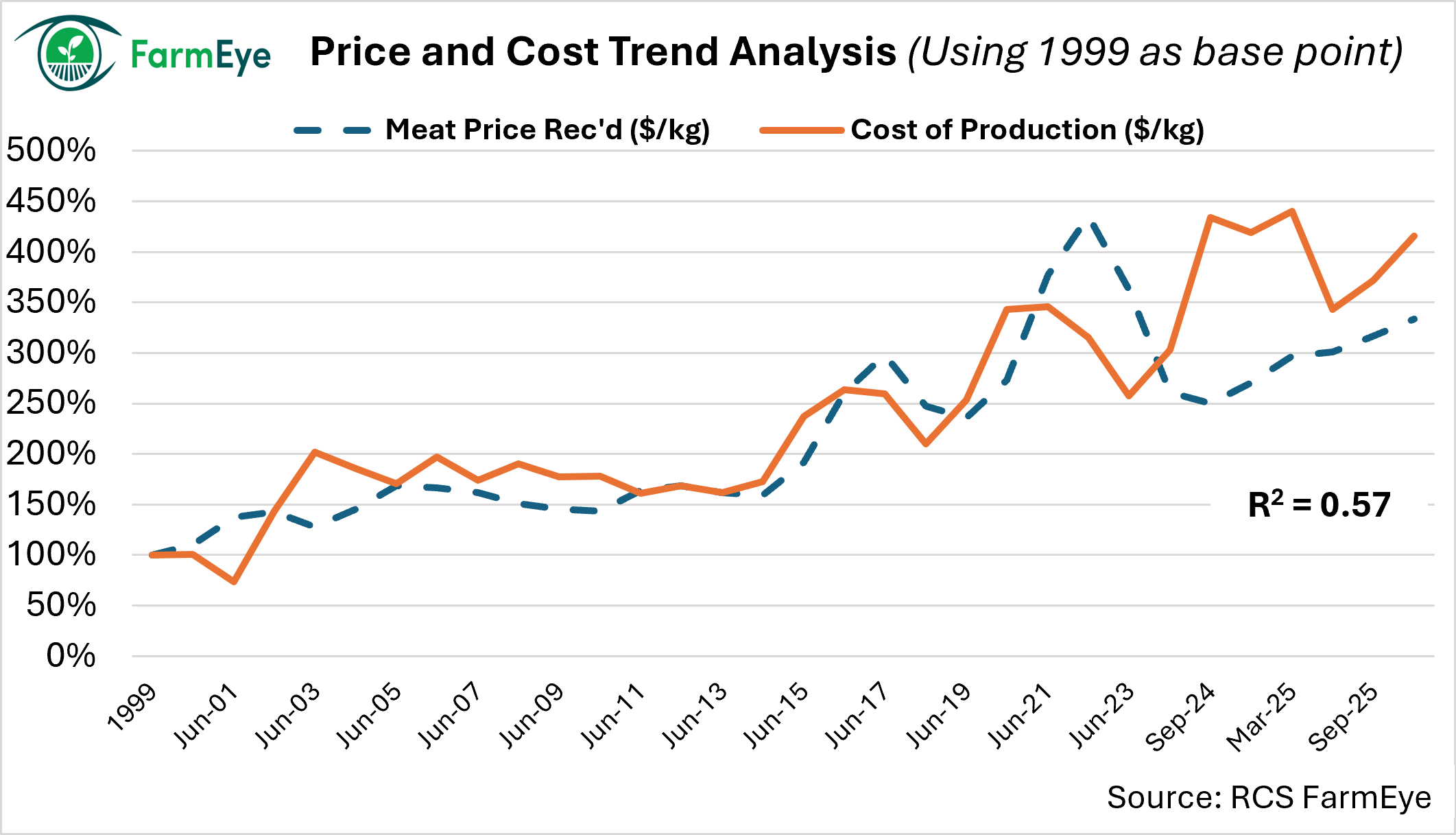
The detail of this argument has consumed much paper (and now water and energy with AI), and it’s a long yarn for another day. What is pressing is the trends visible in our long-term benchmarking and financial data. We see that businesses who have a consistently lower cost of production ($/kg produced), have a consistently higher return on assets (ROA), and are more resilient long term. They can weather the storms of markets and climate variability. Most, not all, would consider themselves excellent land stewards. So, is it possible to look after the landscape (maybe even regenerate it?) and run a super profitable, resilient business? Our answer is a resounding “yes” when doing the right things well.
Does this connect with the way you want to run your farm? If you want to start farming and grazing for profit, a great place to start is with our courses. Click here to find out more.